The 24 solar terms: a solar calendar inside the lunar calendar
Lập xuân, Đông chí and Thanh minh follow the Sun, not the Moon. What the 24 solar terms are, why Lập xuân rarely falls on Tết, and how the terms decide leap months.
Flip through a Vietnamese wall calendar and next to the lunar and solar dates you will often see a small extra line: “Lập đông”, “Tiểu tuyết”, “Đông chí”… These are tiết khí, the solar terms. Many people think solar terms are part of the lunar calendar, but they actually follow the Sun, not the Moon.
Solar terms are measured by the Sun’s position
Over a year, seen from Earth, the Sun travels once around the sky along a path called the ecliptic. That circle is divided into 24 points, each 15° apart. Each time the Sun reaches one of these points, a new solar term begins.
The 0° mark is Xuân phân (Spring Equinox). Every further 15° starts the next term: Thanh minh at 15°, Cốc vũ at 30°, and so on up to Đông chí (Winter Solstice) at 270° and Lập xuân (Start of Spring) at 315°. Each solar term lasts about 15 or 16 days.
Because they follow the Sun, solar terms fall on almost the same Gregorian date every year, shifting by a day at most. That is why Lập xuân is usually on 4 or 5 February.
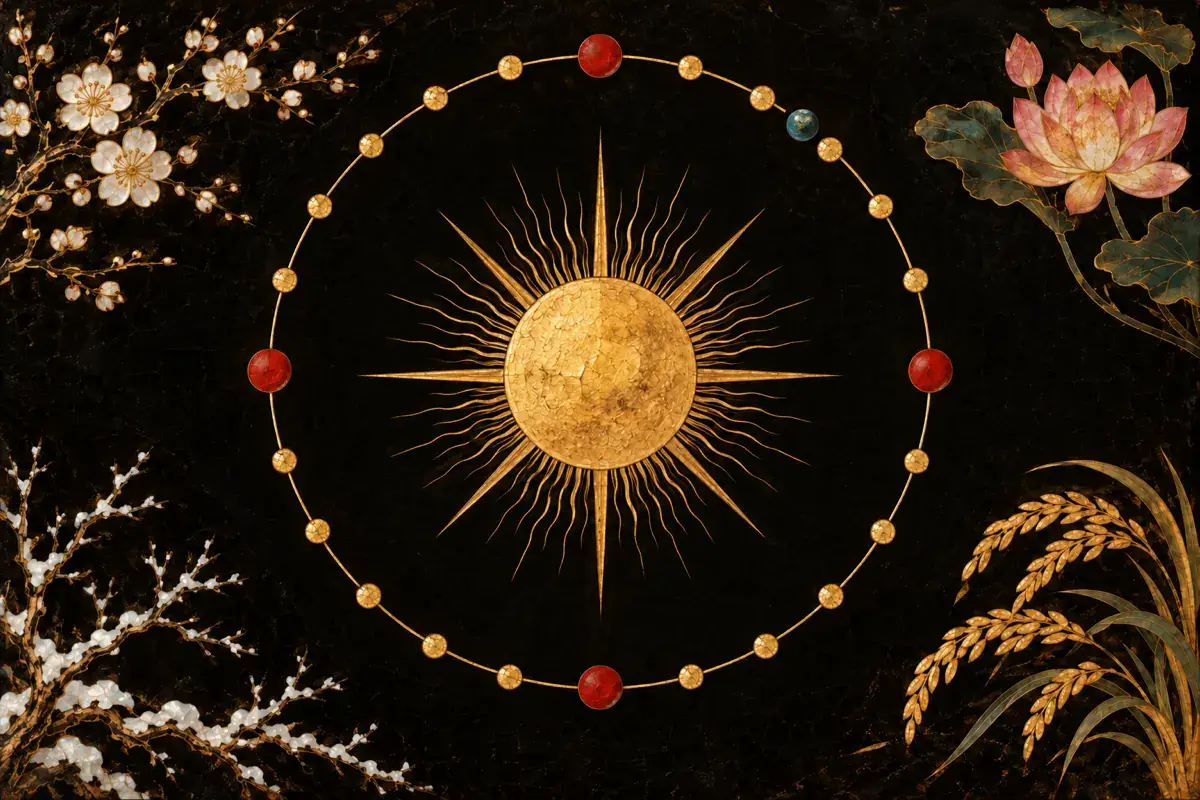
The 24 solar terms by season
Each name is a short description of the weather or the farming season:
- Spring: Lập xuân (start of spring), Vũ thủy (rain water), Kinh trập (insects waking), Xuân phân (mid-spring, day and night nearly equal), Thanh minh (clear and bright), Cốc vũ (rain for the grain).
- Summer: Lập hạ (start of summer), Tiểu mãn (grain slightly full), Mang chủng (grain in ear), Hạ chí (midsummer, the longest day in the Northern Hemisphere), Tiểu thử (minor heat), Đại thử (major heat).
- Autumn: Lập thu (start of autumn), Xử thử (end of heat), Bạch lộ (white dew), Thu phân (mid-autumn, day and night nearly equal again), Hàn lộ (cold dew), Sương giáng (frost descends).
- Winter: Lập đông (start of winter), Tiểu tuyết (minor snow), Đại tuyết (major snow), Đông chí (midwinter, the longest night in the Northern Hemisphere), Tiểu hàn (minor cold), Đại hàn (major cold).
The names reflect the climate where the calendar was born. Weather in different parts of Vietnam can be quite different: the south gets no snow at Tiểu tuyết or Đại tuyết. For farmers, markers like Lập xuân are still the time to get tools and land ready for the new crop.

Four dates you can check
Xuân phân, Hạ chí, Thu phân and Đông chí are also the four astronomical events that observatories publish. According to U.S. Naval Observatory (USNO) data for 2024, converted to Vietnam time:
| Solar term | Moment (Vietnam time) |
|---|---|
| Xuân phân (Spring Equinox) | 20/3/2024, 10:06 |
| Hạ chí (Summer Solstice) | 21/6/2024, 03:51 |
| Thu phân (Autumn Equinox) | 22/9/2024, 19:44 |
| Đông chí (Winter Solstice) | 21/12/2024, 16:20 |
This shows that solar terms are not rough conventions: they match real astronomical moments that can be calculated to the minute. Calendar software uses astronomical formulas (such as Jean Meeus’s) to compute the Sun’s longitude and find when each term begins.
Why Lập xuân rarely falls on Tết
Tết Nguyên đán, the Lunar New Year, is the first day of the first lunar month, so it is counted by the Moon. Lập xuân is counted by the Sun. The two are worked out differently, so they have no fixed link, and Lập xuân only now and then lands exactly on the first day of Tết.
This matters in Bát tự (Four Pillars). In Bát tự the new year starts at Lập xuân, not at Tết, and each month also starts at a solar term. So someone born after Tết but before Lập xuân may have a different year stem and branch from their usual “lunar age”.
Solar terms decide the leap month
The lunar calendar needs the solar terms so that it does not drift away from the seasons. Of the 24 terms, the 12 at even multiples of 30° (such as Xuân phân at 0° and Đông chí at 270°) count as principal terms (trung khí). The lunar month that contains Đông chí is month 11.
A lunar month averages about 29.53 days, so 12 lunar months come to only about 354 days, around 11 days short of one trip of the Sun. After a few years there will be a lunar month containing no principal term. Under the rule of the traditional Chinese calendar, which the Vietnamese lunar calendar also uses, that month becomes the leap month. This keeps Tết always at the end of winter and the start of spring.
Solar terms in the Qelunai app
In the Calendar tab of the Qelunai app, the “Coming up” list shows the day each solar term begins, along with the first and fifteenth of each lunar month. Dates are worked out in Vietnam time, so they can differ by a day from calendars printed in other countries. You can also take a quick look on our lunar calendar page.
Next time you see “Lập đông” on a calendar page, you will know the Sun has just reached 225° on the ecliptic.
Sources
- Wikipedia, "Solar term"
- Báo Văn hóa, "Tại sao tiết Lập xuân thường không thể trùng đúng mùng 1 Tết"
- Báo Quốc tế, "Vì sao lập xuân luôn vào ngày 4 hoặc 5 tháng 2 Dương lịch?"
- U.S. Naval Observatory, Earth's Seasons (dữ liệu năm 2024)
- Wikipedia, "Four Pillars of Destiny"
- doxuta/amlich, DESIGN.md (cách tính kinh độ Mặt Trời)
- Jean Meeus, Astronomical Algorithms, ấn bản 2, Willmann-Bell, 1998
Articles are cultural reference, not professional advice. Illustrations drawn by AI.